Tag along for a comparative study of Silicon Carbide (SiC) and Quartz wafer boats. You’ll compare their atomic structure and bonding, manufacturing process, properties, and lifespans.

Definitions
What are Silicon Carbide Wafer Boats?
SiC wafer boats are high-purity, thermal-resistant, advanced ceramic carriers used to hold or transport SiC wafers during their manufacture.
The boats are made from sintered or recrystallized silicon carbide.
You’ll find that they demonstrate impressive properties like superior thermal resistance, excellent electrical stability, and high power density. Hence, they don’t creep during extreme semiconductor or photovoltaic fabrication processes like annealing, diffusion, and oxidation.
What are Quartz (SiO2) Wafer Boats?
Quartz wafer boats are predominantly made of fused silicon oxide. You use them to carry or support silicon wafers during semiconductor processing stages like chemical vapor deposition (CVD) and diffusion.
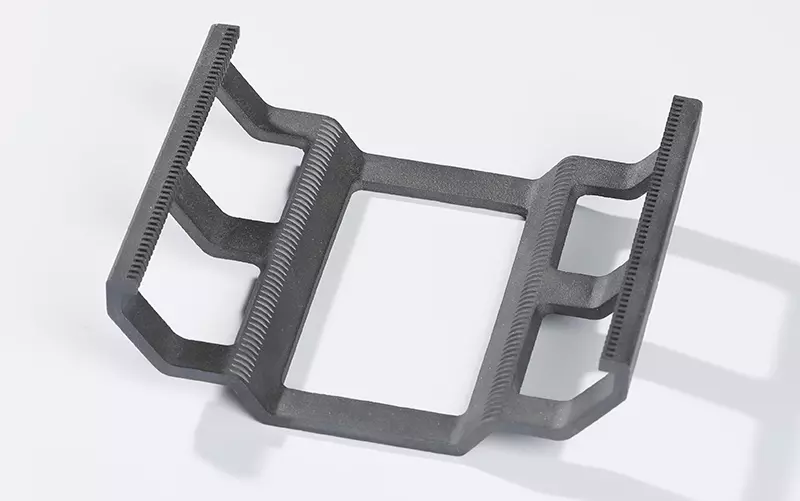
These silicon dioxide wafer boats have attractive features, such as chemical inertness and thermal stability. Hence, they are resilient in high-temperature photovoltaic or semiconductor processes.
Structure and Bonding
What is Silicon Carbide’s Structure and Bonding?
Silicon carbide (SiC) is made up of silicon and carbon atoms. The compound exists in different crystal structures, with the 4H-SiC being used in power semiconductors.
Below is the compound’s structure.
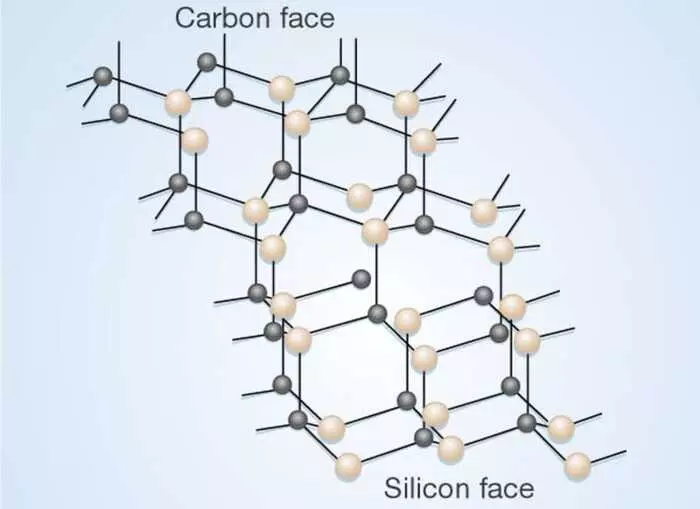
The figure shows you four carbon atoms and four silicon atoms bonded with a central silicon and carbon atom. The four carbon and four silicon atoms link through their corners to form a tetrahedral unit. You realize that when stacked, the units form a polar structure called a polytype. 4H-SiC is an example of a polytype.
What is Quartz’s Structure and Bonding?
SiO2’s natural-appearing form (Quartz) has a giant covalent structure, as you can see below.
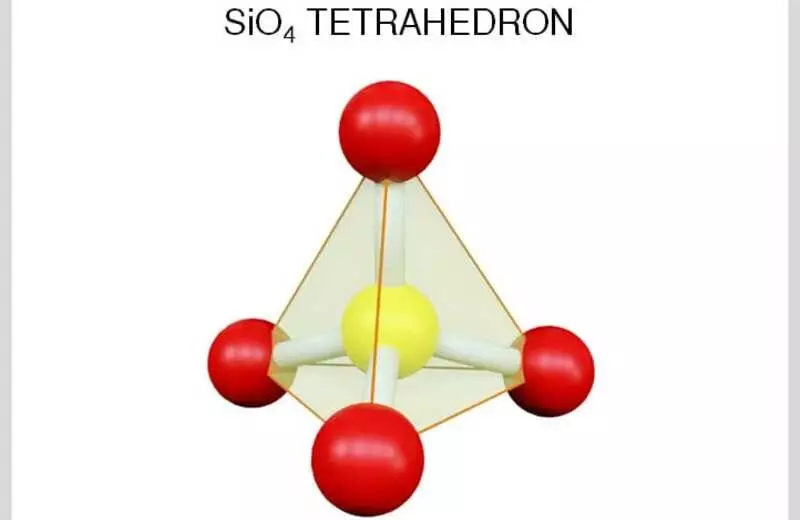
SiO2 is a compound of silicon and oxygen atoms. One silicon atom bonds with four oxygen atoms, while a single oxygen atom bonds with two silicon atoms.
SiO2 has a tetrahedral arrangement of atoms, similar to that of diamond. You find that the atoms are bound by strong covalent bonds, which contribute to SiO2’s high melting and boiling points.
Properties
What Properties Must a Semiconductor Wafer Boat Have to Perform Effectively?
Purity: Your semiconductor wafer boat must be over 99.99% pure. Otherwise, impurities will interfere with critical processes like diffusion and chemical vapor deposition.
Superior flexural strength: Wafer boats must inherently withstand high mechanical stress. If your wafer carrier warps under extreme conditions, it will compromise the quality of the wafer.
Hardness: Your carrier should have high creep and wear resistance in extreme crystal growth processes.
Chemical resistance: Semiconductor manufacturing involves chemical processes like the Acheson process, crystal growth, and chemical vapor deposition (CVD). Meaning, the wafer boat is always exposed to corrosive gases like ammonia, hydrogen, and Hydrogen Chloride (HCl). The boat must be resilient against these gases.
High thermal conductivity: In crystal growth, heat dissipation will prevent thermal stress on the semiconductor wafers. Hence, an effective wafer boat that facilitates uniform heat is crucial for a high-performing semiconductor.
What are the Properties of Silicon Carbide Wafer Boats?
|
Property |
Value |
|
Temperature stability |
Over 1,700°C |
|
Thermal conductivity |
23W/m.K |
|
Silicon percentage |
Over 99.9% |
|
Density |
2.6 to 2.7 g/cm³ |
|
Elastic modulus |
240 GPa |
To be more specific, let’s show you the properties of the 4H-SiC polymer. This crystal structure is applied in semiconductor or photovoltaic wafer boats. You’ll find this structure has superior properties, hence, its even better output performance.
|
Property |
Typical Value |
|
Crystal structure |
Hexagonal crystal structure |
|
Space group |
C46v-P63mc |
|
Bandgap reference |
3.23 eV |
|
Density |
3.21 g/cm3 |
|
Bulk Modulus |
320 GPa |
|
Pearson Symbol |
hP8 |
|
Cell parameters |
3.0730; 10.053Å |
|
Thermal conductivity |
370W/m.k |
While sintered SiC ceramics typically have a 23W/m.K thermal conductivity, you will notice 4H-SiC has a higher thermal conductivity of 370W/m.k. This explains why the single-crystal polymer has different application scenarios.
The global silicon carbide wafer market is projected to reach USD 3154 million by 2031, fueled by a 14.8% CAGR. PR Newswire UK.
What are the Properties of Quartz Wafer Boats?
|
Property |
Typical Value |
|
Crystal structure |
Trigonal crystal structure |
|
Space group |
P3121 (space group 152) - P3221 (space group 154) |
|
Bending strength |
Up to 67 MPa |
|
Density |
2.2 g/cm3 |
|
Max. working temperature |
1,200°C |
|
Hardness |
6.5 Mohs |
|
Purity |
99.99% Silicon Oxide |
Why are Silicon Carbide Wafer Boats Better than Silicon Dioxide?
Silicon Carbide Wafer Boat Properties Vs. Quartz
|
Property |
SiC Wafer Boat Value |
Quartz Value |
|
Max. working temperature |
Over 1,700°C |
1,200°C |
|
Chemical inertness |
Very good |
Average |
|
Contamination chances |
Very low |
High |
|
Thermal expansion |
Low |
Average |
|
Service years |
Many |
Few |
What are the Advantages of Silicon Carbide Wafer Boats Against Quartz Wafer Boats?
Silicon carbide’s maximum working temperature for the long term is higher than that of quartz. This shows you the ability to work in elevated temperatures without reactions or any structural changes for many years.
With a higher chemical inertness, you realize silicon carbide wafer boats operate in highly corrosive semiconductor procedures, unlike Quartz.
Your silicon carbide wafer boats have a lower risk of contamination than their quartz counterparts. Hence, SiC can perform effectively in many semiconductor processes without requiring sintering again.
Silicon carbide is different from Quartz in that it has a three times higher energy gap. This means the energy it takes to elevate an electron from the valence to the conduction band is three times.
This energy gap facilitates a 10-times stronger electric field strength. With this, wafers and wafer boats can be lightweight and manage strong electric fields.
Frequently Asked Questions
1.Why Do Silicon Carbide Wafer Boats Last Longer than Quartz Boats?
SiC wafer boats’ maximum working temperature is 1,700°C compared to quartz’s 1,200°C. Meaning, SiC wafer boats have a lower coefficient of thermal expansion and higher thermal expansion than Quartz.
2.Do SiC Boats Meet Semiconductor Manufacturing Anti-Contamination Standards?
Yes. Your SiC wafer boats’ chemical inertness improves semiconductor manufacturing yields. They generate fewer particles than Quartz in diffusion and epitaxial growth processes.
3.Which Wafer Boats are Preferred for Warpage Prevention?
SiC wafer boats are better at preventing warpage than Quartz boats. Their incredible thermal stability provides a resilient support for large-diameter wafers, efficiently preventing bowing.
4.Are SiC Wafer Boats Preferred for Automated Robotic Loading?
Yes. SiC boats are better at handling automated and manual loading than Quartz. Your SiC boats’ high thermal conductivity enhances uniform heat distribution, making it a strong wafer carrier that won’t creep.
5.What are the Disadvantages of SiC Wafer Boats?
The main downside of SiC wafer carriers is their high purchase price. However, the product’s longevity and high-performance output will facilitate efficient wafer support for the long term.
6.Where Can You Buy a Custom Wafer Boat?
GORGEOUS CERAMIC (GGSCERAMIC) is among the best wafer boat manufacturers, offering both standard and custom wafer boat ceramics. Logging in to the company website shows you their different manufacturing scales, from prototype to mass production.
You get industry-standard and customized solutions for different economic sectors. That includes aerospace, auto, medicine, and chemical engineering.
Click here to get a quote!
Conclusion
So far, we hope that you can sift through suppliers based on your industry needs. A good SiC wafer boat manufacturer should withstand extreme conditions without wearing off sooner than required. It should have a high energy gap and be chemically inert to reduce the chances of contamination, etc.