Are you curious about how MCH heating elements, ceramic heating rods, and ceramic heating plates are manufactured?
GORGEOUS CERAMICS(GGS) will take you behind the scenes to fully reveal the manufacturing process of ceramic heating elements, showing you every key step from raw materials to finished product.
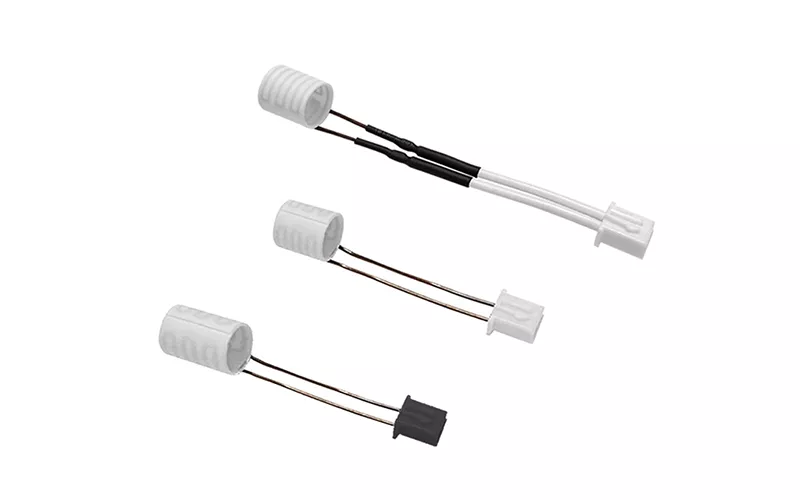
Ceramic heating elements for 3D printers
Basic Process of Ceramic Heating Element Manufacturing
The basic manufacturing process of ceramic heaters using tape casting:
Tape casting of ceramic substrate – Printed circuit board – Molding – Sintering – Post-processing
Powder preparation
In the preparation for manufacturing ceramic heaters, GORGEOUS CERAMICS(GGS) uses high-purity ceramic powders as raw materials, such as alumina (Al₂O₃) and aluminum nitride (AlN).
We mix the powders with various organic solvents and binders, and then perform the mixing process in a ball mill for 12-24 hours, ultimately forming a slurry with uniform particles and good flowability.
Ceramic Sheets Produced by Tape Casting
After preparing the ceramic slurry, the next step is to pour it into a tape casting machine and spread it evenly on the PET film using a doctor blade. The doctor blade height, the viscosity of the ceramic slurry, and the casting speed are key parameters in this process. Only by controlling these parameters can high-quality ceramic green sheets be formed after drying.
The freshly made ceramic green sheets are typically only 0.1-1 mm thick. The green sheets produced through tape casting not only have uniform thickness but also a smooth surface, laying a solid foundation for subsequent printed circuits.
Slicing / Punching
For the ceramic green sheets after tape casting, GORGEOUS CERAMICS(GGS) will process them according to the dimensions required by the customer, and process the ceramic sheets using stamping, laser cutting, die cutting and other processes according to the customer’s choice, to obtain ceramic substrate green bodies of the required dimensions.
Printing Heating Circuit
This step is a key step in manufacturing MCH ceramic heating elements. GORGEOUS CERAMICS(GGS) will use screen printing or thick film printing according to different situations, and print conductive materials such as tungsten (W), molybdenum (Mo), and molybdenum manganese (Mo-Mn) onto the ceramic green body according to customer requirements. After completing the heating circuit, electrodes, and contact terminals, the ceramic green body will be dried at low temperature, waiting for subsequent processes.
Lamination / Forming
In this process step, GORGEOUS CERAMICS(GGS) will carry out different treatments on the products according to different customer requirements. If it is a ceramic heating plate, we will laminate it directly, using the form of “ceramic—heating circuit—ceramic” for hot press lamination. For ceramic heating rods, the ceramic sheets will be curled / wound, attaching the printed circuit ceramic sheet onto the prepared ceramic rod and rolling it into a cylindrical shape. When attaching the tape cast sheet into a cylinder, a gap of 0.5 to 1 mm needs to be reserved to allow space for thermal expansion and contraction.
Debinding
In the powder preparation stage, binders and various organic substances are added, so the debinding process is required. The ceramic green body is heated at a temperature of 200–600 ℃ to gradually decompose the organic substances. If the debinding process is not properly controlled, problems such as cracking, blistering, and deformation may occur in the product. Therefore, GORGEOUS CERAMICS(GGS) will conduct strict inspection and sampling checks to improve the product yield rate.
High-Temperature Sintering
Sintering is the most critical step in advanced ceramic manufacturing and is also one of the core advantages of GORGEOUS CERAMICS(GGS) in terms of technical accumulation and process control. At this stage, the formed and printed ceramic green bodies are sent into a high-temperature sintering furnace, where the temperature is controlled at 1600–1650 ℃, and the sintering process is controlled according to a precise heating curve.
During the sintering process, diffusion and rearrangement occur again among the ceramic powders, resulting in densification. As the internal pores of the ceramic are significantly reduced, it ultimately becomes a high-strength, high-density ceramic structure. At this time, the heating circuit printed on the ceramic surface also forms a firm and integrated structure with the ceramic substrate.
For defective products that may occur during sintering, GORGEOUS CERAMICS(GGS) can effectively avoid common issues such as cracking, warping, and structural deformation. We precisely control key parameters such as sintering temperature, heating rate, furnace atmosphere, and holding time to ensure that the sintered ceramic products have stronger mechanical strength and a longer service life.
In addition, the advantage of GORGEOUS CERAMICS(GGS) lies in years of sintering experience and the accumulation of temperature control technology. We have customized dedicated sintering process curves for ceramic heating elements of different structures and specifications, ensuring that each piece has stable quality performance.
Terminal Connection
After sintering is completed, the electrode terminals still need to be connected. We usually select processes such as silver soldering, nickel soldering, and laser welding according to customer requirements to connect a proper power interface.
Finishing
After completing the connection of the power interface, we can further carry out finishing processes on the ceramic heating elements according to the specific application requirements of the product, ensuring that both the dimensional accuracy and surface quality meet the design specifications.
Common finishing processes include outer diameter grinding, surface grinding, and polishing. After these processes, our products can better match different equipment and installation requirements.
Inspection
The final step is inspection. Before leaving the factory, GORGEOUS CERAMICS(GGS) will test each ceramic heater individually. The inspection items include resistance, power, electrical insulation, appearance, dimensions, and thermal uniformity, ensuring that every product is of high quality and high performance.
Summary
The above steps constitute the basic manufacturing process of MCH heating elements. GORGEOUS CERAMICS(GGS) is a professional supplier of customized ceramic heating elements, with well-established production facilities and production lines. We can meet the application needs of different industries, provide various types of ceramic heating elements, and offer one-stop ceramic heating element solutions for a wide range of customers.