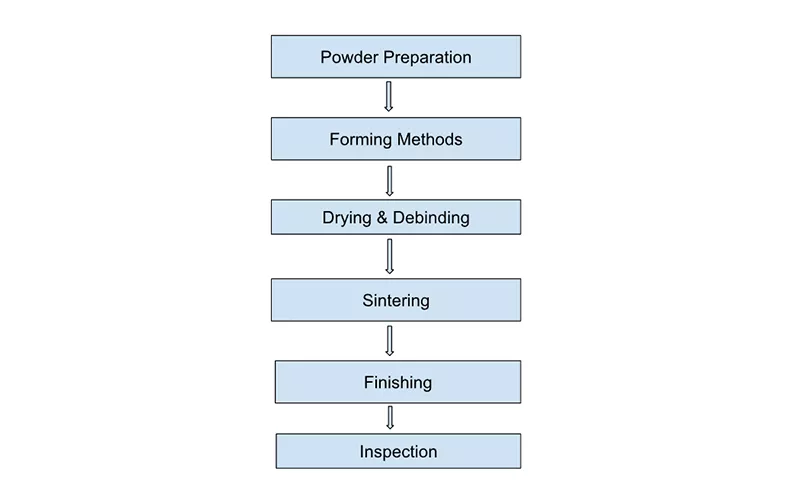
Your powders of high purity are transformed into highly performing components through ceramic manufacturing processes. To yield materials that are stable and dense, your ceramic processes should involve precise steps.
What Are Your Advanced Ceramics?
-
These advanced ceramics are inorganic materials that have higher performance than metals.
-
I truly appreciate that your ceramic manufacturing process starts with >99% purity powders, which ensures uniform surfaces in later stages.
-
Examples of these engineering ceramic materials are aluminum oxide, silicon carbide, and silicon nitride, which offer superior hardness and stability.
Advanced Ceramics Characteristics
What’s the Hardness and Strength of Your Ceramics?
-
They are very hard because materials like your SiC offer 20-25 GPa, Al2O3 12-18 GPa, and B4C 29-35 GPa.
-
Your cutting tools industry will prefer these ceramic materials over for their high compresive strength and wear resistance.
Are Ceramics Thermally Stable?
-
Yes, with a melting point >2000 °C, your advanced ceramic materials deliver peerless thermal stability.
-
Your ceramic products handles >1600 °C in your turbine engines due to their low thermal expansion.
Will Your Advanced Ceramics Resist Corrosion?
Definitely, your technical ceramics resist corrosion on a high level. Due to their inertness, they easily resist alkali, oxidation, and acids at >1600 °C.
What Are the Electrical Features of Ceramic Materials
-
Your advanced ceramic processes produce electrical insulators that are super excellent.
-
As insulators, your they handle high voltages and temperatures. Plus, they are actually customizable as semiconductors.
How Your Industrial Ceramic Manufacturing Process Works
Processing Your Raw Materials (Preparation of Powder)
-
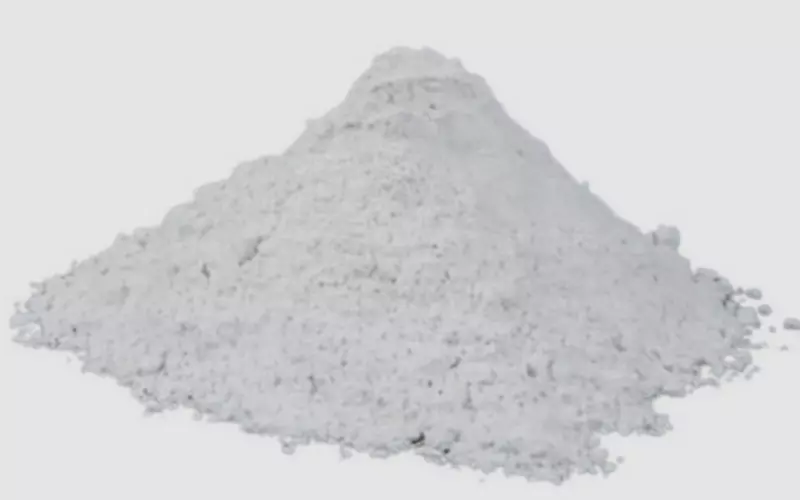
Your advanced ceramics are manufactured using powder, i.e., Fly Ash, a dry solid consisting of small particles. To be successful in the industry, your choice of raw materials must be high quality in both purity and particle distribution.
-
Your high-purity raw materials are produced through synthesis processes, thereby ensuring consistent characteristics.
-
And to achieve uniform particle sizes, your powders are ground in jet mills and then blended with binders.
Creating Parts and Consolidation
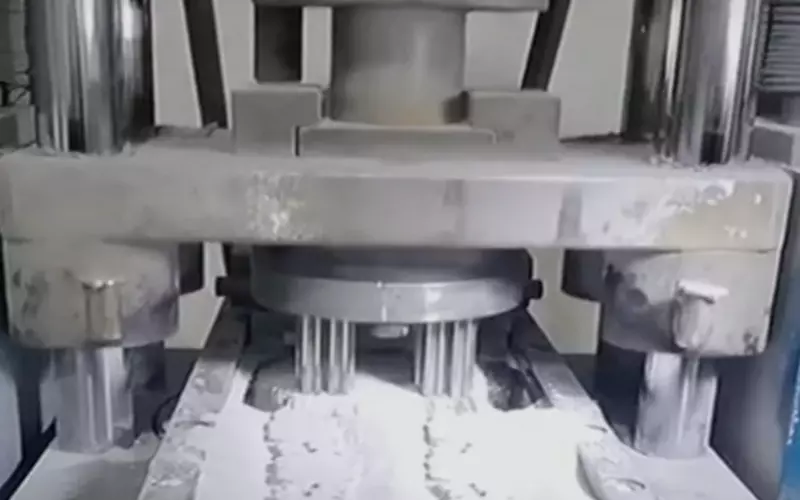
Your advanced ceramics are formed cost-effectively by performing dry pressing, which forms the powders into the desired shapes.
-
Your product is consolidated through the use of isostatically pressed powders such that your finished product contains higher green (unfired) density. It will also have more complex shapes.
-
Your ceramics manufacturing also uses Additive Manufacturing (3D Printing) techniques such as stereolithography for complex, minimal volume components.
Drying and Debinding
-
If your advanced ceramics were not dried prior to sintering, your parts would crack. Therefore, drying your parts (removing the moisture) reduces the likelihood of cracking due to differential expansion.
-
The organic binders and lubricants added to your powders when formed are removed via a heating process. This eliminates any void or defect resulting from the prior addition of the binders and lubricants.
4.4 Ceramic Sintering
-
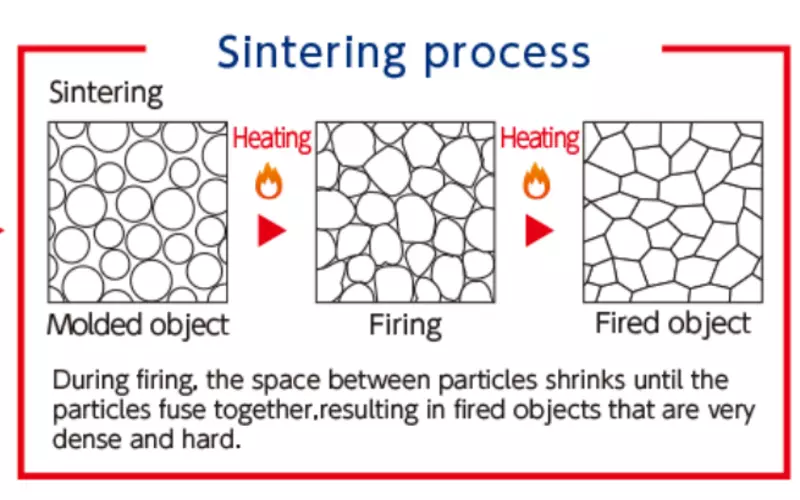
During ceramic sintering, your industry fires your green ceramic parts to produce a dense, industrial ceramic.
-
Densification is achieved through techniques such as pressureless sintering, which involves heating in your conventional furnaces at 1600 °C+.
-
Using your unique form of sintering called Spark Plasma Sintering (SPS), quickly achieves a dense finished product.
-
During your ceramic sintering process, your fine particles transition from loose & porous powder into dense & monolithic solid.
Sintered Ceramic Post-Processing and Finishing
-
Because sintering makes your part shrink by 20-25%, diamond grinding is required to achieve final dimensions.
-
Lapping and polishing produce exceptionally smooth and flat surfaces, eliminating surface flaws. This increases your component’s strength and reduces wear.
- For fragile or high-value ceramic components, controlled movement between finishing, inspection, and storage areas is also important. Well-planned automated material handling systems can help reduce manual handling and improve positioning consistency during production.
-
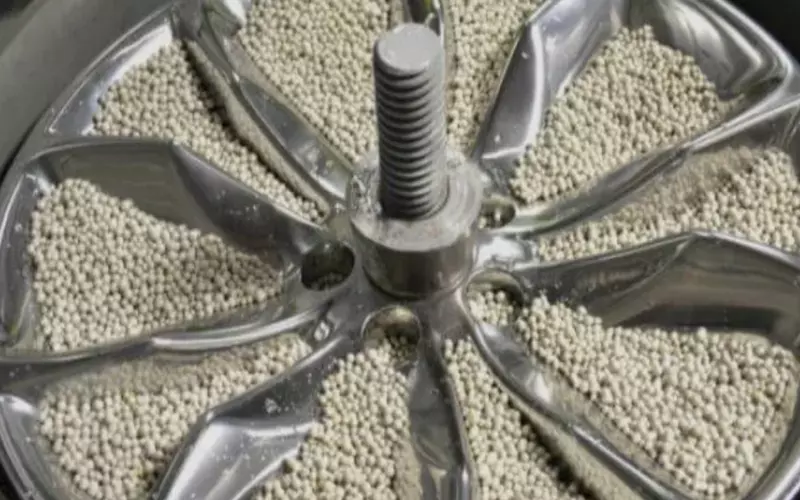
Magnetic Abrasive Finishing (MAF), creates a brush of magnetic ash particles. It then use those to run along the entire surface removing the microscopic peaks off the finish surface.
Inspection
-
Your advanced ceramic manufacturing process ends with visual inspection of the parts and dimensional inspection of your drawings.
-
Visual inspection involves observing for cracks and surface flaws, ensuring surface quality
-
Integrating Non-Destructive Testing (NDT) techniques, such as Ultrasonic testing, detects internal sub-surface cracks.
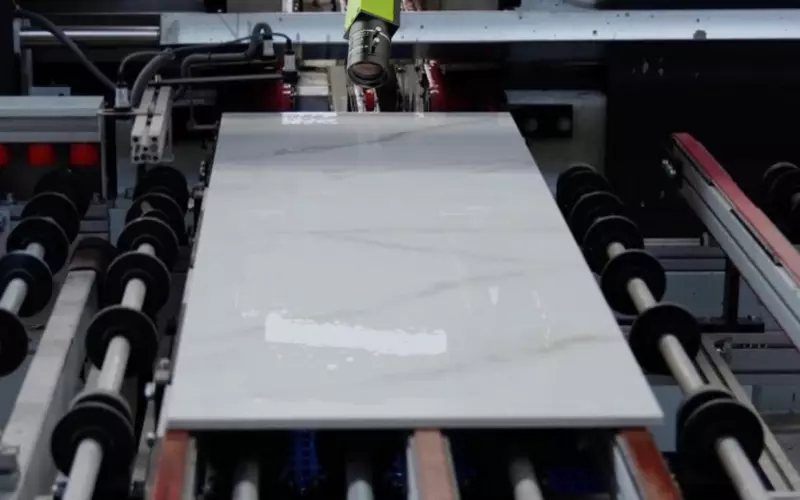
- Dimensional inspection will utilize CNC coordinate measuring machines (CMM) and laser scanners.
Challenges Your Industry Faces in Ceramic Processes
Cost
The cost of producing high purity powder and SiC ceramic powder is high. This is due to the current manufacturing methods and temperatures >1600 °C required for densifying the materials.
Sintering Shrinkage
-
During green body heating, your ceramic parts shrink by 20-25%. Since this shrinking is not uniform, it becomes hard to manage how much your ceramic part will shrink.
-
To facilitate dimensional accuracy, scale your digital models prior to producing your ceramic parts using a specialized spacer or setter.
Brittleness of Ceramics
-
Due to strong ionic and covalent atomic bonds, your ceramics are inherently brittle. The brittle nature of ceramics leads to parts that have sharp corners and surface defects. This allow cracks to initiate and propagate.
-
To mitigate the risk of cracking, engineers should use the methodology of transformation toughening or CMCs.
What Is The Future of Ceramic Manufacturing Methods?
-
New CMCs will allow using fiber reinforcement to fill in the gaps caused by cracks in your ceramic material. CMC materials are critical in high performance materials for highest weight to strength ratio.
-
Integrating AI and machine learning in your ceramic processing transforms your ceramic quality inspection into automated detection. Detection of surface cracks and shade variations with higher precision, has improved process accuracy to 95%+.
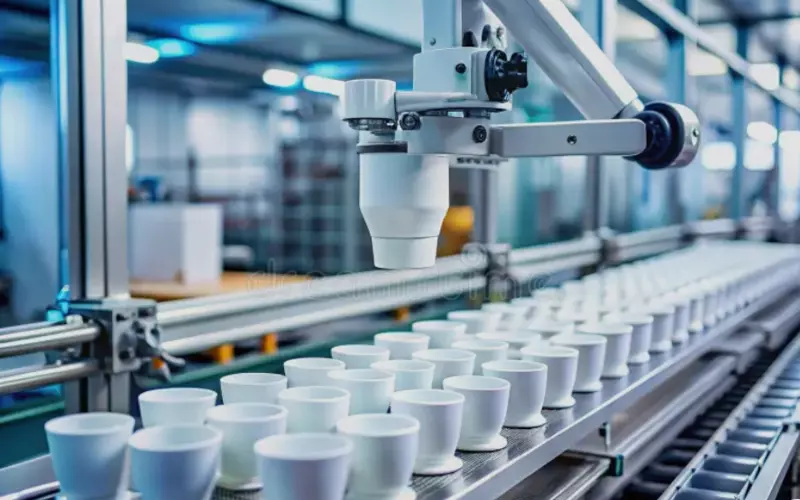
“After integrating AI in our ceramic production, detection of decoration flaws and surface cracks improved significantly. Accuracy increased to 95%, elevating prediction of final dimensions and ensuring precise geometries.” — Haron P., Lead Production Manager at Ceratiles
Ceramic Forming Methods Vs Applications
Advanced ceramic forming methods shape your synthetic, >99% purity powders into dense, precise components. Your manufacturing processes tailor these methods to provide the high strength density needed for electronic, medical, and defense applications.
CeramicFormingMethodsVsApplications_Table1.png
|
Application |
Requirement |
Forming Method |
|
Aerospace & Defense |
Low weight, high strength, heat resistance |
Hot Isostatic Pressing (HIP), Injection Molding, Specialized 3D Printing (SLA) |
|
Electronics |
High dielectric strength |
Tape Casting, Slip Casting, Injection Molding |
|
Cutting tools |
Extreme hardness, wear resistance |
Dry Pressing, Hot Pressing |
|
Medical devices |
High biocompatibility, toughness |
Slip Casting, Specialized 3D Printing (SLA) |
Table: Applications of advanced ceramics based on forming methods
Data source: Mater. Sci. Eng. 2025; 109(2): 021004
Sintered Ceramics Manufacturers & Suppliers
-
Ceramics manufacturers should have technical know how and mastery of every aspect of your industrial ceramic manufacturing process.
-
Manufacturers must also hold ISO and ASTM certifications for quality and purity control in their respective industries.
-
At GORGEOUS CERAMIC( GGSCERAMIC), we guarantee ISO 9001 and industry-approved custom ceramic products.
FAQs About Your Ceramic Processes
Q: Why do customers prefer to buy advanced ceramics preferred over traditional ceramics?
A: Your advanced ceramics provide higher fracture and wear resistance, better temperature and corrosion resistance, and more precise consistency.
Q: How are advanced ceramics made?
A: Your synthetic powders are processed through preparation, forming, debinding, and sintering at >1600 °C.
Q: What are the applications of industrial ceramics?
A: Examples of industries that use ceramics include your refractories, electronics, medical implants, aerospace, and manufacturing tools.
Conclusion: Your Engineering Ceramic Manufacturing Methods
Your ceramic manufacturing methods involve the stages: powder preparation, precision molding, high-temperature sintering, and finishing. All these stages are completed under strict controls to yield dense, high-strength, high-tolerance products.