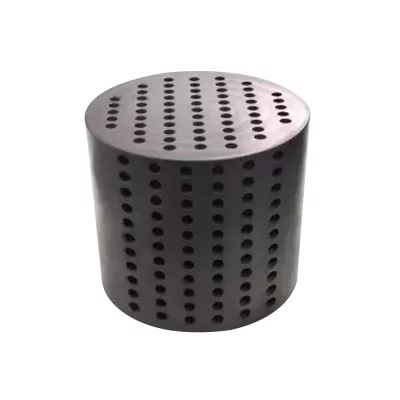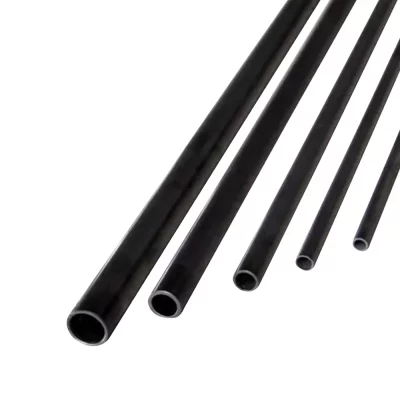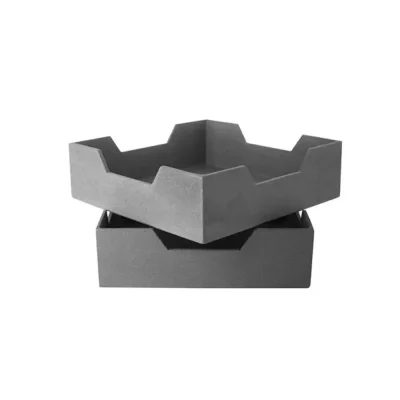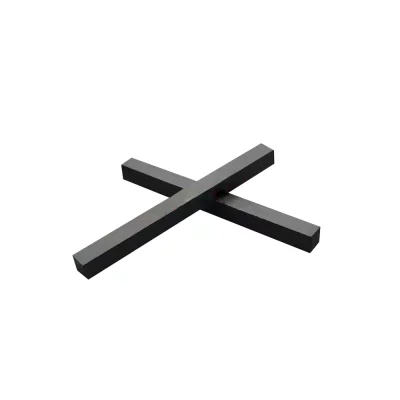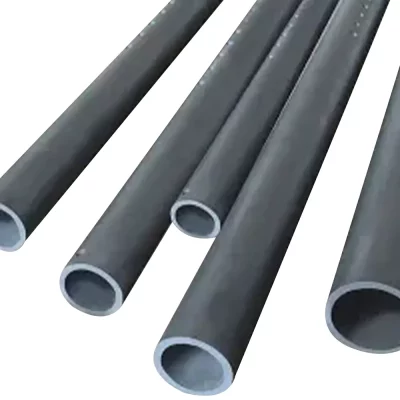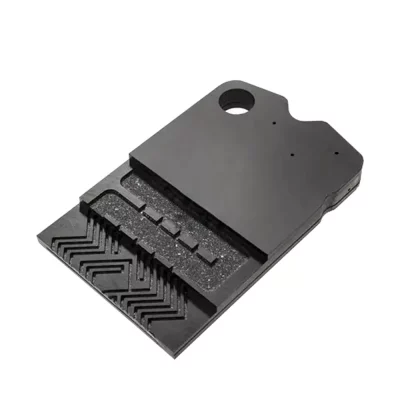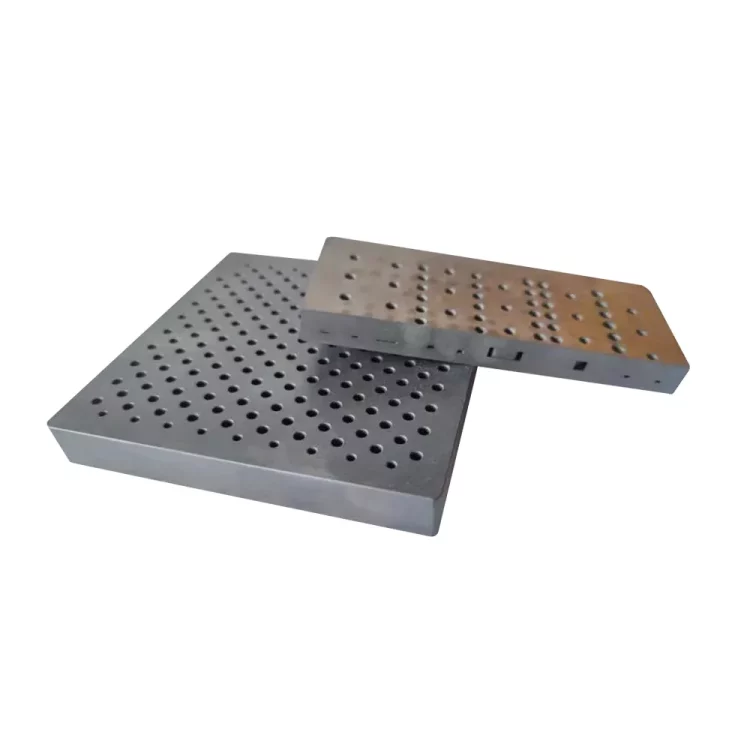
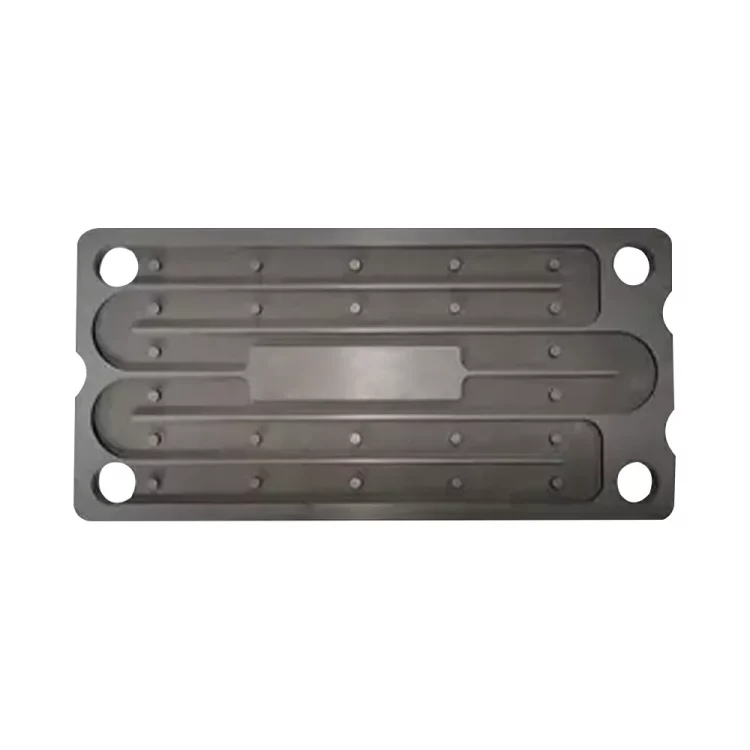
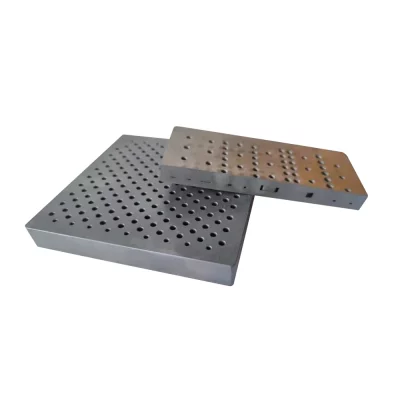
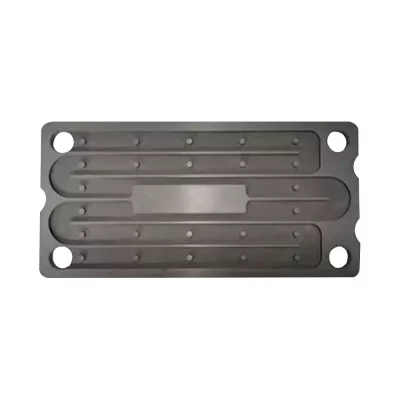
GORGEOUS CERAMICS (GGS Ceramic) silicon carbide heat exchanger plates are made from spray-coated granulated silicon carbide powder, processed by isostatic pressing and pressureless sintering.
We offer customization services, designing and manufacturing various silicon carbide structural components according to customer-provided drawings, with a minimum channel diameter of 1 mm.
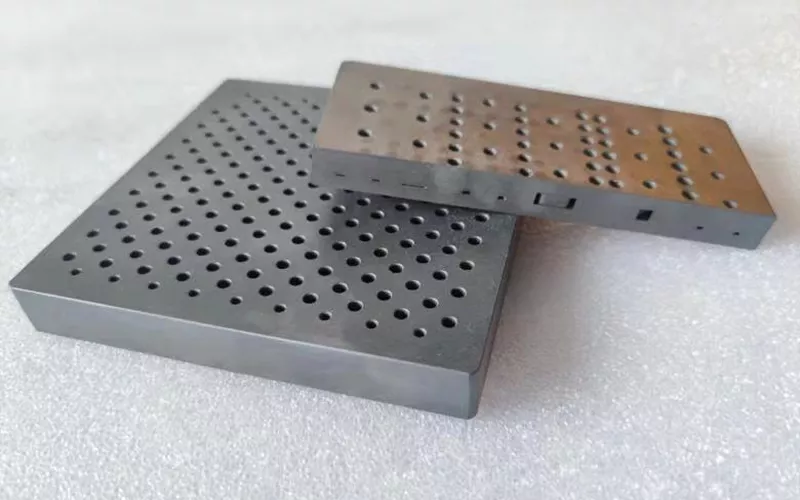
Verpackung
Multi-layer cushioning and customized protection: Each of our silicon carbide heat exchange plates is securely wrapped with high-density EPE pearl cotton or EVA foam, precisely fitting the microchannels and corners for shockproof protection.
Moisture-proof and corrosion-resistant vacuum sealing: The product uses a double-layer seal of vacuum moisture-proof bags and anti-static composite bags to effectively prevent corrosion and moisture during transportation.
Delivery Time
GORGEOUS CERAMICS (GGS Ceramic) supports custom designs based on provided drawings (S-shaped flow channels, 3D bionic microchannels, irregularly shaped interfaces). Thanks to superior production capacity, the lead time for customized samples/bulk orders is only 2-3 weeks, and for large-volume orders, it is only 4-5 weeks.
Silicon Carbide Heat Exchanger Plate Model and Specifications
|
Length Lmm |
Width Wmm |
L/W±Xmm |
Thicknessmm |
T±Xmm |
Parallelismmm |
Flatnessmm |
OberflächenrauheitμM |
|
100 ≤ N ≤ 200 |
100 ≤ N ≤ 200 |
±0.5~±0.7 |
6~30 |
±0.1 |
0.02 |
0.02 |
0.8 |
|
200 ≤ N ≤ 300 |
200 ≤ N ≤ 300 |
±0.7~±1.2 |
8~30 |
±0.1 |
0.02 |
0.02 |
0.8 |
|
300 ≤ N ≤ 400 |
300 ≤ N ≤ 400 |
±1.2~±1.5 |
12~30 |
±0.2 |
0.03 |
0.03 |
0.8 |
|
400 ≤ N ≤ 500 |
400 ≤ N ≤ 500 |
±1.5~±2.0 |
15~30 |
±0.2 |
0.03 |
0.03 |
0.8 |
|
500 ≤ N ≤ 600 |
500 ≤ N ≤ 600 |
±2.0~±3.0 |
18~30 |
±0.2 |
0.05 |
0.05 |
0.8 |
|
600 ≤ N ≤ 700 |
600 ≤ N ≤ 700 |
±2.5~±3.0 |
20~30 |
±0.2 |
0.05 |
0.05 |
0.8 |
|
700 ≤ N ≤ 1000 |
700 ≤ N ≤ 750 |
±3.0~±4.0 |
20~30 |
±0.2 |
0.05 |
0.05 |
0.8 |
Advantages of silicon carbide heat exchange blocks/plates
High thermal conductivity of 160+ W/m·K
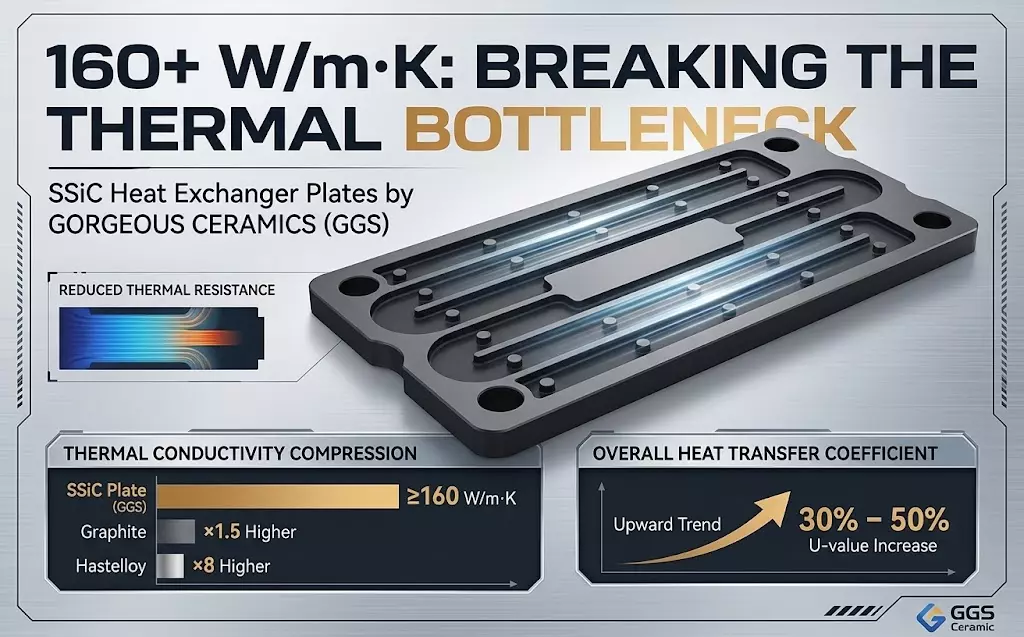
In heat exchange systems operating at high temperatures, with strong exothermic reactions, or in high-flow-rate continuous operation, the thermal conductivity of the heat exchanger material is the decisive factor determining the overall heat transfer efficiency.
GORGEOUS CERAMICS (GGS Ceramic)’s pressureless sintered silicon carbide heat exchanger blocks/plates boast a thermal conductivity of ≥160 W/m·K (8 times that of Hastelloy and 1.5 times that of graphite). With extremely thin wall thickness designs, the overall heat transfer coefficient can be increased by 30%–50%, significantly reducing thermal resistance and heat exchange temperature difference.
Resistant to strong corrosive media
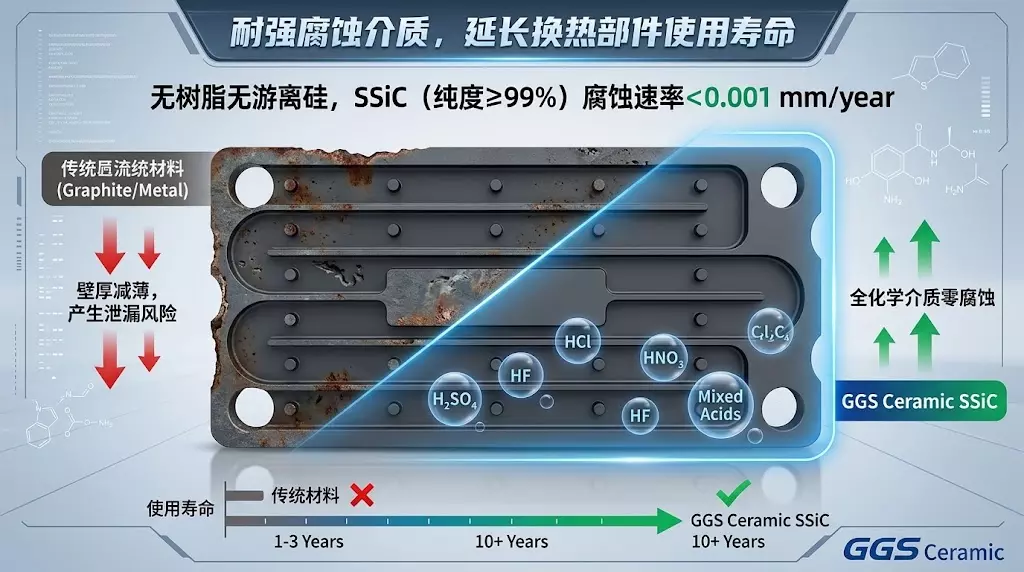
In chemical, semiconductor, pickling, and corrosive fluid handling equipment, heat exchange plates are in long-term contact with media such as sulfuric acid, hydrochloric acid, nitric acid, hydrofluoric acid, and mixed acids. If the materials used do not have superior corrosion resistance, the heat exchange plate wall thickness will be reduced, creating a risk of leakage.
GORGEOUS CERAMICS (GGS Ceramic) uses high-purity pressureless sintered silicon carbide (SSiC, purity ≥99%), producing no free silicon and containing no resin binders. It can withstand zero corrosion from all chemical media except high-temperature concentrated phosphoric acid (>200℃) and molten alkali, with a corrosion rate of <0.001 mm/year, completely eliminating the risk of cross-contamination and leakage.
Microchannel precision machining can achieve a minimum diameter of 1 mm
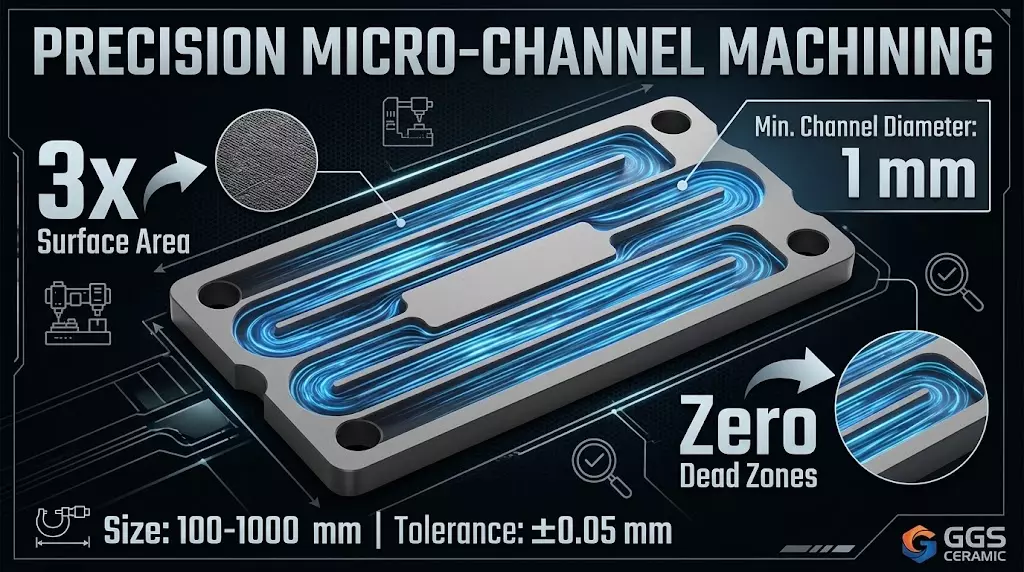
The core of a heat exchanger lies not only in the physical properties of the material itself, but also in the structural design of its internal flow channels. GORGEOUS CERAMICS (GGS Ceramic), through a combination of isostatic pressing, pressureless sintering, and 5-axis CNC precision machining, can achieve microchannel apertures as small as 1 mm. Compared to large flow channels of 5-8 mm, this directly increases the heat transfer surface area by three times, significantly enhancing the internal turbulence effect of the fluid and greatly improving the thin-film heat transfer coefficient.
Furthermore, single-plate/block sizes cover 100-1000 mm, with channel position accuracy controlled within ±0.05 mm. It supports cross-flow, counter-flow, S-shaped, and complex 3D biomimetic flow channel designs, effectively balancing fluid resistance and completely eliminating heat exchange dead zones.
Häufig gestellte Fragen
1.What are silicon carbide heat exchanger blocks/plates?
Silicon carbide heat exchanger blocks or plates are high-performance ceramic components with internal flow channels designed to achieve efficient heat transfer in high-temperature and high-pressure environments.
2.Why is silicon carbide used for heat exchanger blocks and plates?
Siliziumkarbid is used in heat exchangers because this material possesses extremely high thermal conductivity, corrosion resistance, and thermal shock resistance. These properties make silicon carbide an ideal material for applications where metal materials are unsuitable.
3.What are the main applications of silicon carbide heat exchanger blocks?
The main applications of this product include petrochemicals, acid and alkali heat recovery systems, pharmaceutical processes, and waste heat recovery.
4.What are the advantages of silicon carbide heat exchangers compared to metal heat exchangers?
Compared to metal heat exchangers, silicon carbide offers superior corrosion resistance, higher operating temperatures, and a longer service life.