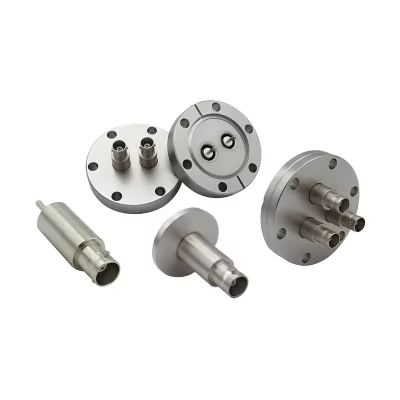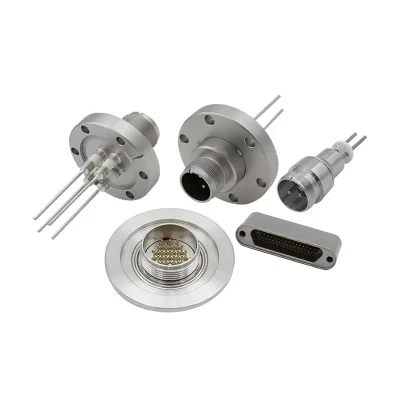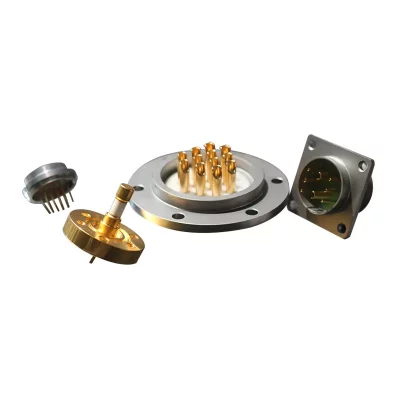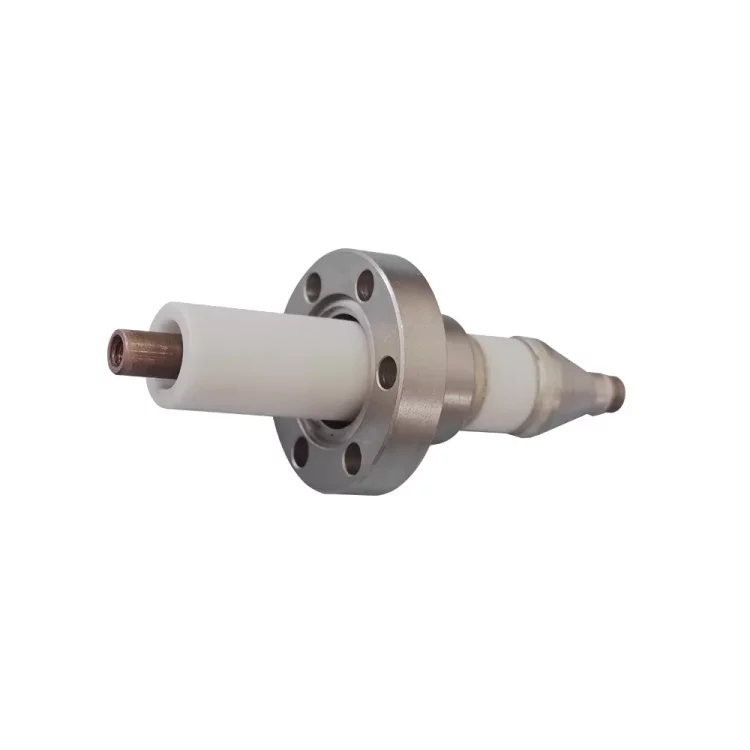
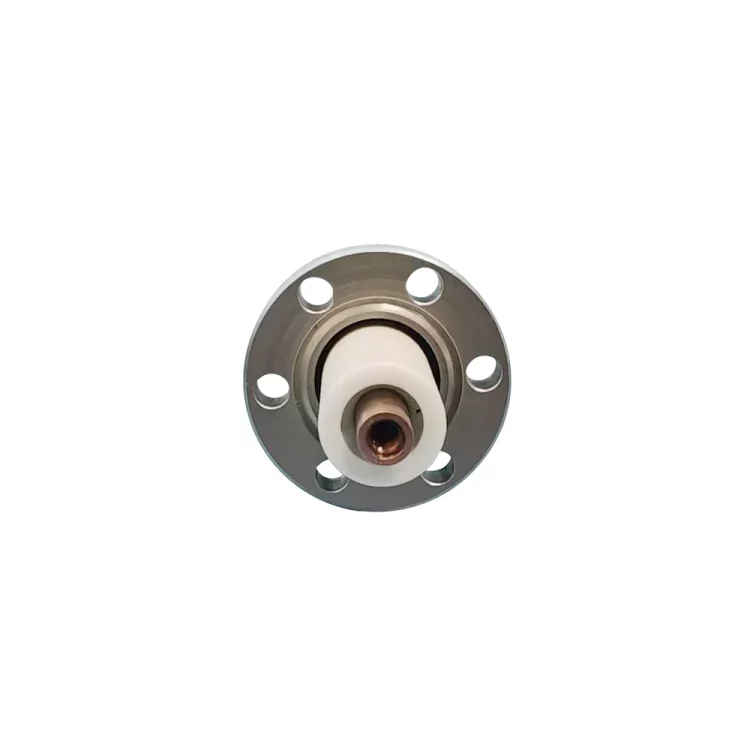
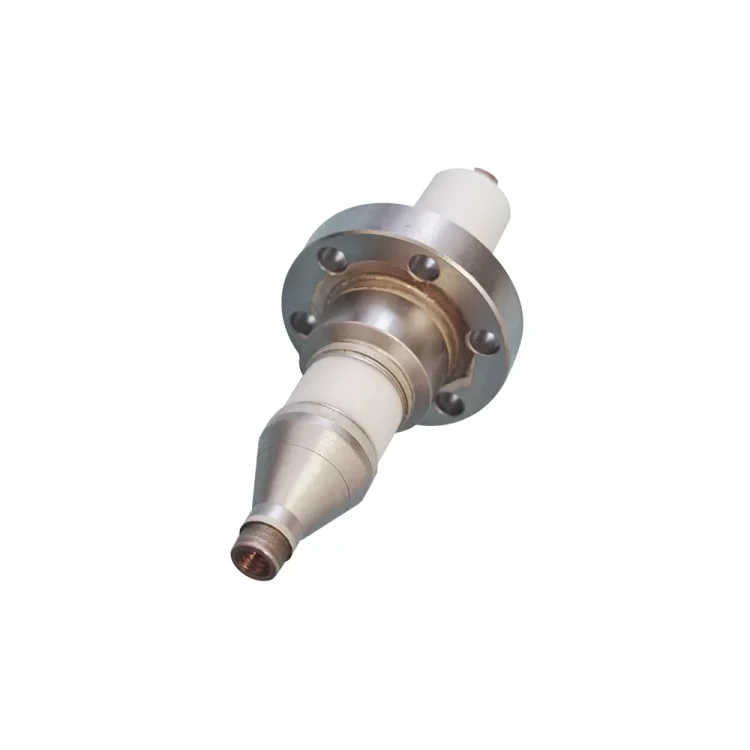
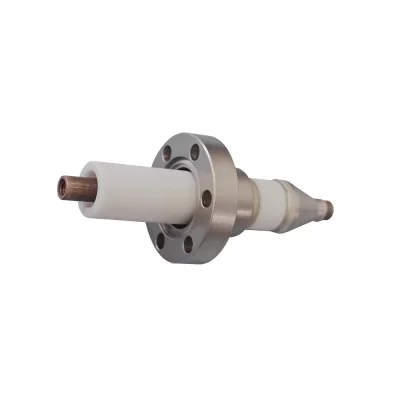
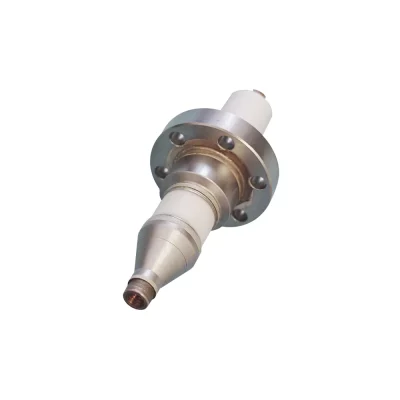
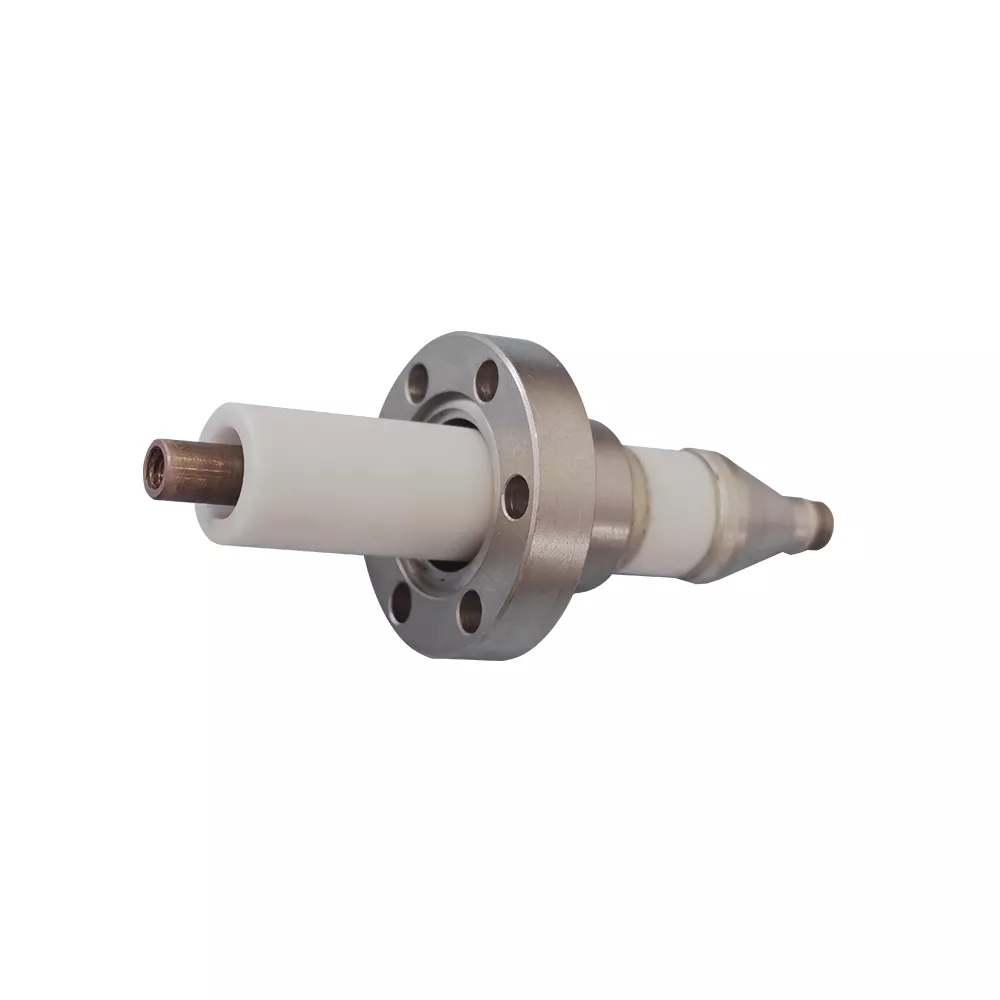
GORGEOUS CERAMICS (GGS Ceramic) has developed a high-voltage, high-vacuum feedthrough specifically for its customers. This product features a leak rate of less than 1×10⁻¹⁰ mbar·L/s (verified via helium leak detection), maintains a vacuum level of 1×10⁻¹⁰ mbar at 15 kV, and has a rated current of 3 amperes.
As shown in the image, the weld lip is constructed from 304 stainless steel or Kovar alloy, the ceramic component consists of 95% alumina (white glazed), and the conductive center pin is made of 5mm pure copper with custom internal threading.
The ceramic is brazed to the stainless steel under controlled temperature and pressure conditions using our proprietary, custom-built vacuum furnace. Upon completion, every unit undergoes 100% inspection using specialized helium leak detection equipment to verify seal integrity and leak rates, with full testing conducted at pressures exceeding 1.2 times the standard negative pressure rating.
Ventajas del producto
In terms of performance
Airtightness: One of the greatest risks for vacuum equipment is the issue of imperceptible, minute leaks occurring over time. GORGEOUS CERAMICS (GGS Ceramic) employs a highly mature ceramic-to-metal brazing process—utilizing materials such as alumina, 304/316 stainless steel, and Kovar alloys (4J33/4J34) via custom specialized techniques—to create a dense, vacuum-tight seal. This structure withstands long-term vacuum environments and extreme temperature fluctuations ranging from -270°C to 600°C. Rigorously tested using precision helium leak detectors, the components demonstrate a leak rate of less than 1×10⁻¹¹ mbar·L/s during 50-second vacuum tests, ensuring your vacuum equipment remains free from leakage risks over the long term.
High-Voltage Insulation: High-voltage feedthroughs require reliable insulation capabilities during power or signal transmission to ensure the safe operation of precision equipment—such as Hall thrusters, high-voltage electron guns, and magnetrons—by preventing electrical contact or conduction with the housing. The insulating components of GORGEOUS CERAMICS (GGS Ceramic) feedthroughs are made from high-density alumina ceramic with a purity of over 95% (99.5% alumina is available for specialized requirements). With a volume resistivity exceeding 10¹⁴ Ω·cm at room temperature (25°C), these components effectively prevent issues such as insulation breakdown and electrical leakage.
High-Temperature Resistance—For equipment and components such as vacuum arc chambers, X-ray tubes, and wall-penetrating electrodes, our high-voltage feedthroughs not only meet your vacuum and high-voltage requirements but also feature ceramic insulation capable of withstanding temperatures up to 1600°C; the complete feedthrough assembly can endure temperatures ranging from 350°C to 600°C (depending on the specific brazing and metal materials selected).
From a manufacturing process perspective
Smooth Ceramic Insulator Surface – The insulating ceramic surfaces of GORGEOUS CERAMICS (GGS Ceramic) feedthroughs are smooth, which minimizes contaminant accumulation and reduces the risk of surface discharge. We offer custom precision grinding and finishing to meet your specific requirements, achieving surface roughness as fine as Ra ≤ 0.2 μm.
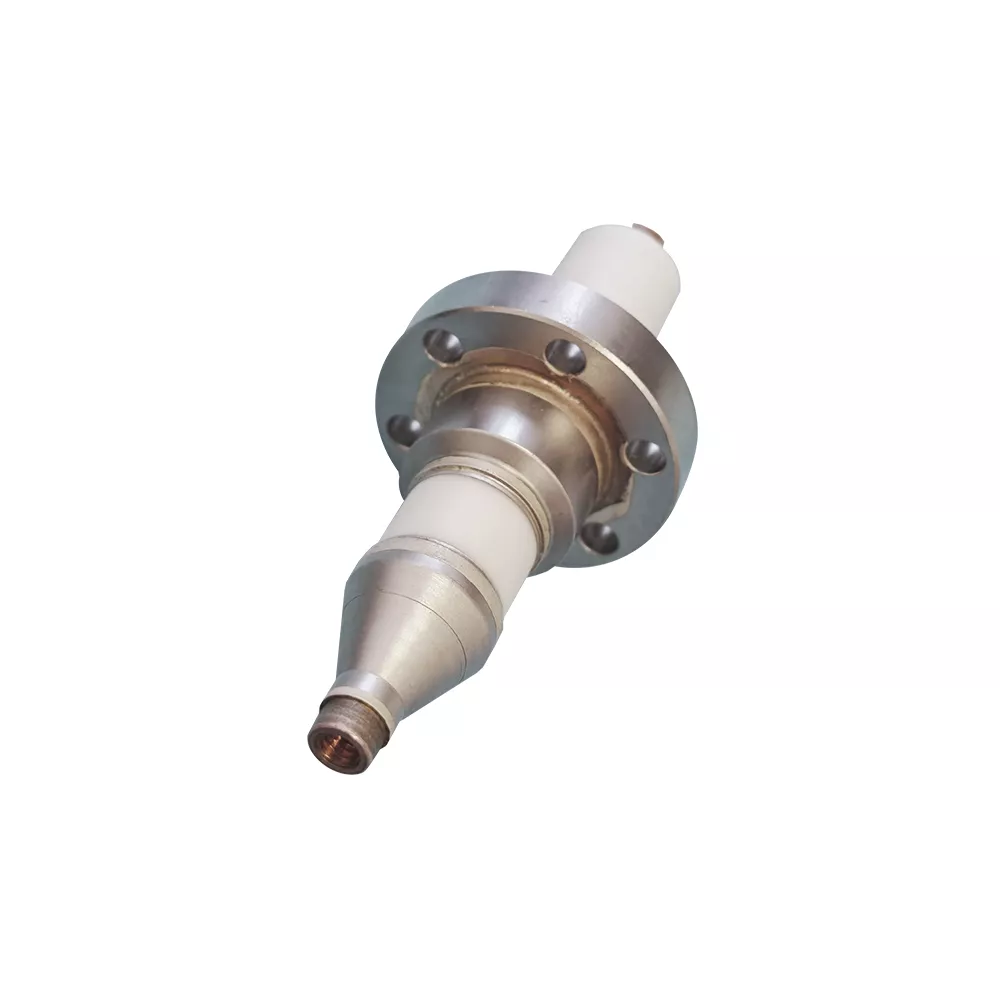
Ceramic-to-metal brazing — specifically the vacuum brazing seal and the bonding of dissimilar materials—determines the quality of feedthrough products.
Due to the differing coefficients of thermal expansion between ceramic and metal, conventional welding methods often lead to cracking.
In contrast, GORGEOUS CERAMICS (GGS Ceramic) employs a unique vacuum brazing process utilizing materials with matched expansion coefficients and a proprietary brazing alloy. This ensures uniform, robust, and defect-free joints without micro-gaps, allowing for rigorous quality control through multiple inspections using ultrasonic and X-ray testing.
All our products undergo 100% testing with high-precision helium leak detectors; standard products achieve a helium leak rate of ≤1×10⁻¹⁰ Pa·m³/s, while customizable high-end models achieve ≤1×10⁻¹¹ Pa·m³/s.
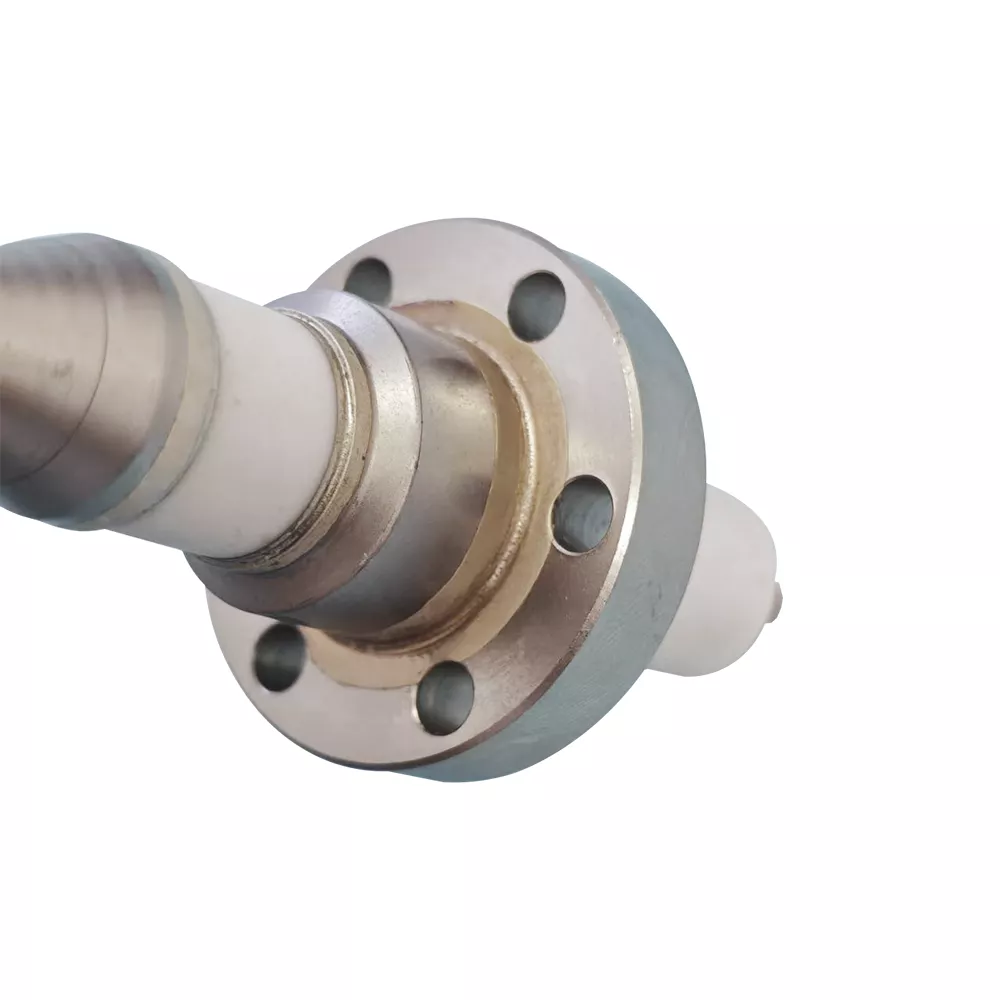
High-Coaxiality Flange Machining – If a high-pressure feedthrough flange is installed misaligned, it can lead to uneven stress on the sealing ring, potentially causing gas leaks and a shortened service life. GORGEOUS CERAMICS (GGS Ceramic) achieves a coaxiality of ≤0.02 mm and a flatness of ≤0.02 mm in flange machining, with CNC dimensional tolerances of ±0.01 mm; this ensures successful installation on the first attempt and eliminates the need for on-site readjustment.
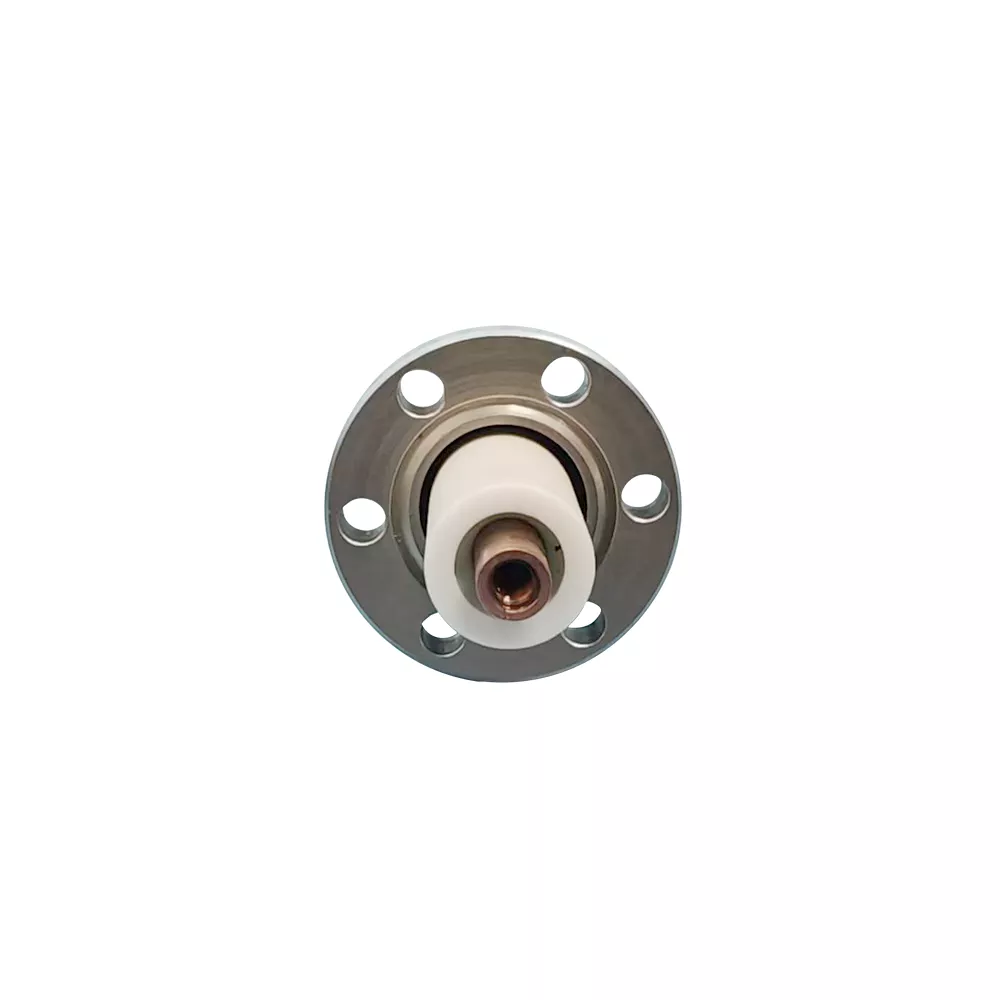
Brazing of Various Conductor Materials – Feedthrough conductor material selection varies depending on the application environment; the most suitable material should be chosen based on actual operating voltage, current, temperature, and vacuum conditions.
Engineers at GORGEOUS CERAMICS (GGS Ceramic) can customize the optimal solution to meet your specific industry requirements.
Conductor Material Recommendation Chart
|
Conductive materials |
Características |
|
Kovar |
Its coefficient of thermal expansion is close to that of Al2O3, ensuring a reliable seal; it is highly recommended, though the cost is higher than that of 304 or 316L. |
|
304 Stainless Steel |
It offers high strength and lower costs compared to 316L, making it suitable for vacuum equipment and components such as standard high-voltage electron guns, wall-penetrating electrodes, and vacuum interrupters. |
|
316L stainless steel |
Lower outgassing rate, superior corrosion resistance, and higher cost compared to 316L. |
|
OFHC Copper |
Electrical conductivity ≥101% IACS; offers excellent electrical conductivity and is suitable for high-current feed-through applications. |
|
molybdenum |
It is resistant to high temperatures and has an extremely low vapor pressure, allowing for long-term use in a 1000°C vacuum environment. |
|
Tungsteno |
Excellent high-temperature resistance |
GORGEOUS CERAMICS (GGS Ceramic) provides customized solutions based on the operating voltage, rated current, installation method, vacuum level, and working environment of customer equipment.
Our company can optimize insulation distance, conductor size, ceramic structure, and flange interfaces for various applications such as semiconductor equipment, vacuum coating equipment, electron beam equipment, particle accelerators, vacuum furnaces, X-ray equipment, and mass spectrometers, ensuring products achieve both ultra-high insulation and sealing performance.
GGS Ceramic Technical Support
Operating Voltage: Tens of kilovolts, specifically designed to meet your requirements
Current Capacity: 3 amps (customizable from milliamps to tens of amps)
Flange Interfaces: CF, KF, ISO, and non-standard interfaces
Includes single-pin, multi-pin, and combined feedthroughs, vacuum-side and air-side connection options, OEM/ODM customized designs.
GGS Ceramic Vacuum High Voltage Feedthrough Case Solution
Customer Case Study 1:
A customer used a standard adhesive sealing method to lead out high-voltage wires in an ultra-high vacuum measurement system. When the system vacuum level was raised below 10⁻⁸ mbar, a slight leak occurred at the interface, causing measurement data drift, data transmission distortion, and preventing stable and accurate experimental completion.
GGS Ceramic’s Solution:
Utilizing a structure of 95% alumina ceramic + 304 stainless steel flanges, and employing a vacuum brazing process to form a ceramic-metal seal, this solution supports operating conditions of 15kV/3A, eliminating fundamental leaks and ensuring successful experimental completion and accurate data acquisition.
Customer Case Study 2:
During the construction of an ultra-high vacuum testing platform, the customer needed to simultaneously introduce high-voltage power and measurement signals. The existing feedthrough structure, employing a multi-layer adapter solution, resulted in a large number of interfaces and complex connections, requiring the vacuum chamber to be disassembled and reassembled each time a test module was replaced.
GGS Ceramic’s Solution:
Using a multi-pin combined vacuum high-voltage feedthrough, high-voltage power supply and signal transmission are integrated into a single flange assembly. Using multi-channel pins and a customized CF flange interface, the high-voltage and signal channels are effectively isolated, and a vacuum brazing integral seal is achieved. Ultimately, our product successfully reduced installation time by approximately 60%, effectively reducing components and lowering your failure rate and overall cost.
Customer Case Study 3:
A customer discovered microcracks in the sealing structure of their vacuum heat treatment furnace due to thermal expansion mismatch.
GGS Ceramic’s Solution:
We use Kovar alloy flanges, which effectively reduce the difference in thermal expansion between the metal and the alumina ceramic. Furthermore, we optimize the structural stress distribution, making customized products more adaptable to high-temperature thermal cycling environments, significantly improving product defect rates and ensuring a stable delivery of high-quality components.
Customer Case Study 4:
The customer needed to provide a stable high voltage to the X-ray tube during the manufacturing of medical imaging equipment. However, the existing feedthrough had an electric field concentration problem, leading to partial discharge during high-voltage operation.
GGS Ceramic’s Solution:
Optimized the ceramic insulation structure and conductor layout for the customer’s operating voltage (increasing insulation distance and optimizing conductor shape), increased creepage distance, and improved electric field distribution, reducing the possibility of partial discharge.
What are the applications of vacuum high-pressure feedthrough?
Used in semiconductor manufacturing equipment
High-voltage feedthrough introduces high-voltage power from the atmospheric side into the vacuum process chamber, primarily powering core components such as plasma and electrostatic chucks, and maintaining a stable ultra-high vacuum environment.
Aplicaciones principales:
PECVD
LPCVD
ICP Etcher (Inductively Coupled Plasma Etching)
RIE (Reactive Ion Etching)
PVD sputtering equipment
ALD (Atomic Layer Deposition)
Ion Implanter
Used in vacuum coating equipment
It can serve as a connection component for the vacuum chamber of targets, electrodes, and electron guns in PVD, magnetron sputtering, and electron beam evaporation equipment.
Aplicaciones principales:
Magnetron Sputtering
Electron Beam Evaporation
Arc Evaporation
Ion Plating
Used in X-ray equipment
In industrial X-ray tubes and scientific X-ray sources, high voltage is required to drive the anode and cathode to generate X-rays. Vacuum feedthroughs can be used to introduce X-rays into the vacuum tube.
Aplicaciones principales:
Industrial X-ray inspection equipment
X-ray CT
XRF (X-ray fluorescence analysis)
XRD (X-ray diffractometer)
Preguntas frecuentes
What is vacuum high-pressure feedthrough?
Vacuum high-voltage feedthroughs are sealed components used to maintain the airtightness of a vacuum and safely introduce high-voltage current or signals into a vacuum chamber. These products typically consist of insulating ceramics, glass, metal flanges, and conductive leads.
Which Chinese suppliers offer leading or cost-effective, stable, and reliable vacuum high-voltage feedthroughs?
GORGEOUS CERAMICS (GGS Ceramic) – Primarily focuses on ceramic-metal vacuum brazing, high-voltage vacuum feedthroughs, and customized precision ceramic component machining, supporting OEM/ODM development.
Inluohua – Primarily provides alumina metallized ceramics, vacuum feedthroughs, X-ray, and semiconductor-related ceramic components.
Fuzhou MK – Offers ceramic-metal seals, high-voltage feedthroughs, and vacuum insulation components, covering industrial and research fields.
XC – Provides multi-pin ceramic feedthroughs, vacuum flanges, and ceramic components for semiconductor equipment.
How to choose a reliable vacuum high-voltage feeder supplier?
You should focus on the following aspects when evaluating a supplier: their extensive experience in ceramic-metal seal manufacturing, their ability to employ vacuum brazing processes, their capacity to provide helium mass spectrometry leak detection reports, and their support for OEM/custom design and precision CNC machining capabilities.
For high-vacuum applications, a supplier’s machining capabilities are often more important than the price of the product itself.
Can GGS’s vacuum high-voltage feedthrough replace European and American brands?
Yes, GORGEOUS CERAMICS (GGS Ceramic) is a stable and reliable supplier of feedthrough and vacuum connectors. We support large-scale customized development based on customer-provided drawings or samples, and can customize flange dimensions, mounting methods, pin counts, operating voltages, and material configurations.
We maintain strong partnerships with numerous suppliers of industrial and semiconductor equipment, helping our customers reduce procurement costs and shorten delivery cycles.