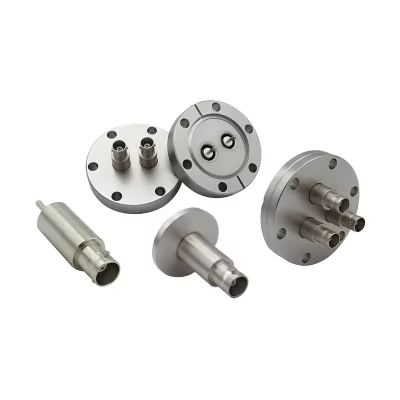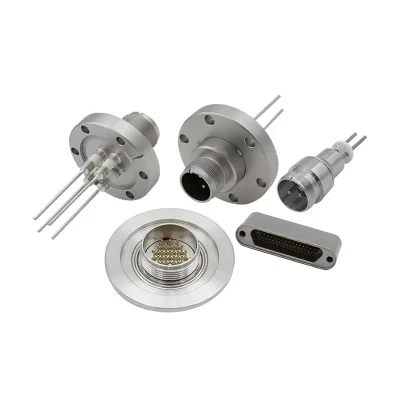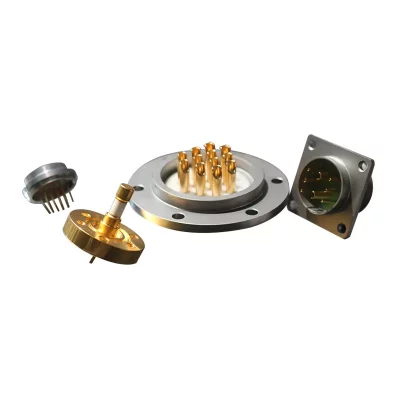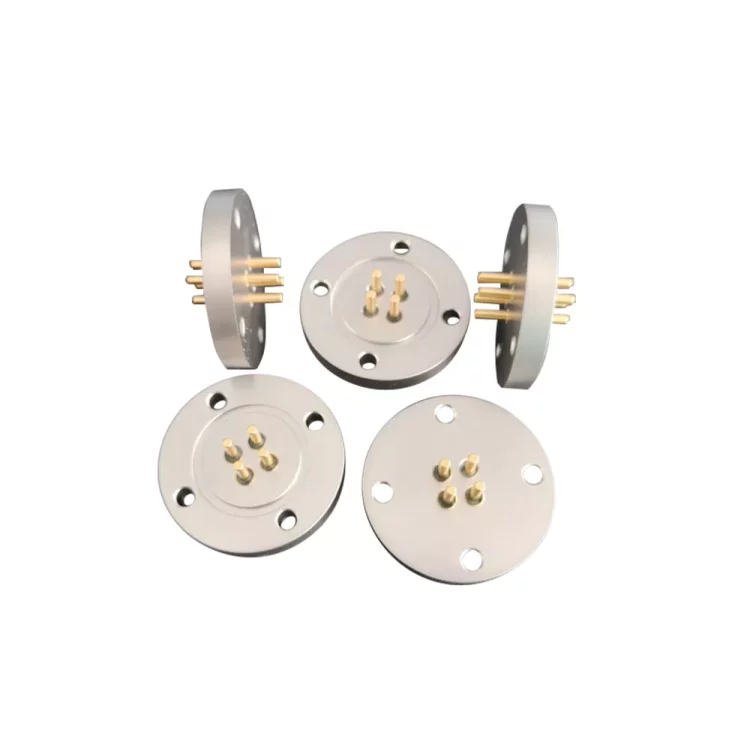
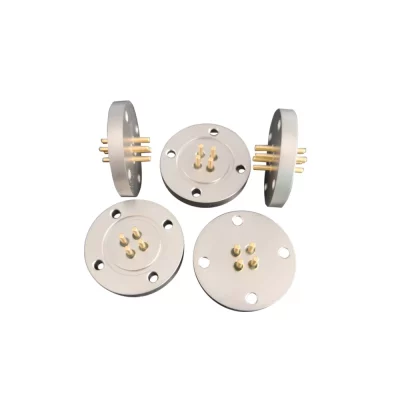
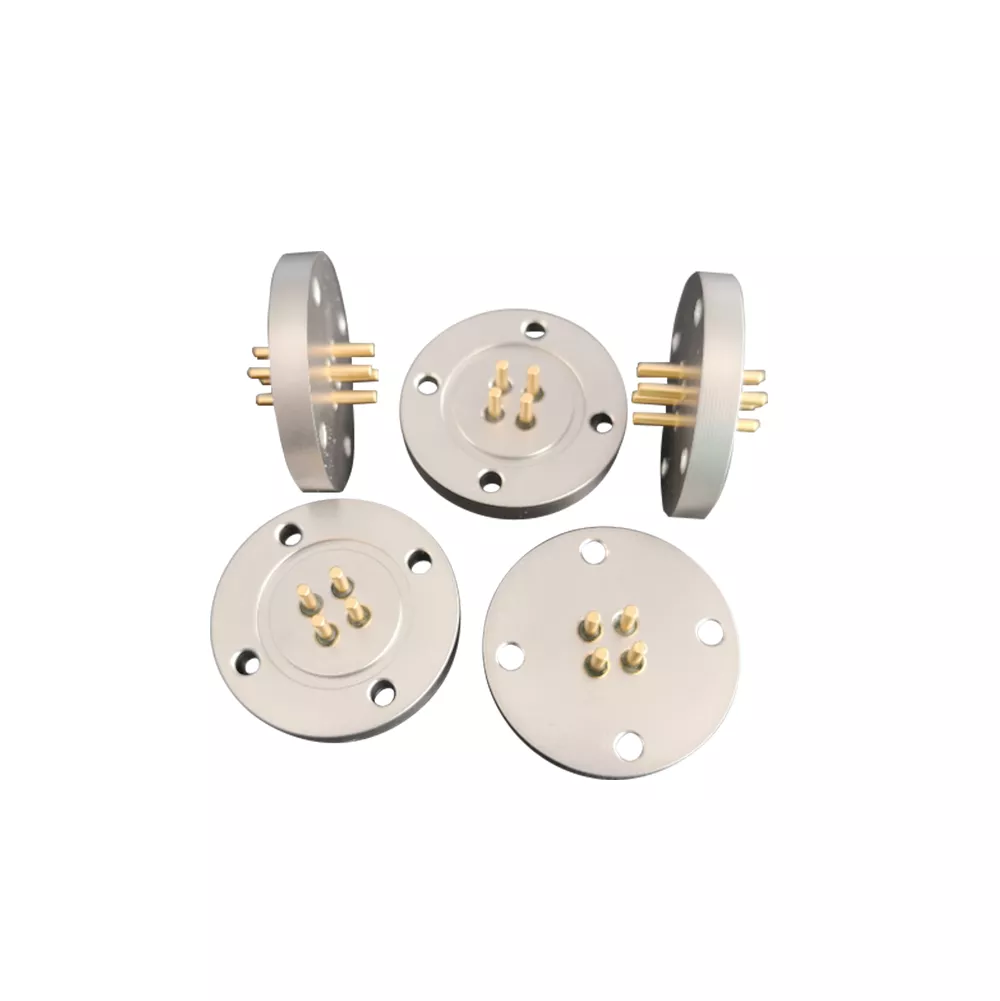
Vacuum feedthrough devices are sealed connection devices specifically designed for high vacuum and ultra-high vacuum (UHV) environments. These products reliably transmit power, signals, and fluids from the atmospheric side to the vacuum side without compromising system integrity.
GORGEOUS CERAMICS (GGS Ceramic) products utilize advanced ceramic-metal sealing technology, achieving extremely low leakage rates (≤1×10⁻¹¹ mbar·L/s), making them ideal for applications such as semiconductor processing, particle accelerators, vacuum deposition, surface analysis, and electron microscopy.
Ürün Avantajları
Zero-leakage vacuum seal, eliminating the risk of leakage
For vacuum feedthroughs, the most critical issue is leakage. Leakage can lead to a series of serious problems, such as vacuum buildup failure, semiconductor equipment shutdown, and inability to image in electron microscopes, resulting in substantial economic losses.
GORGEOUS CERAMICS (GGS Ceramic)’s high-performance vacuum feedthroughs guarantee “zero leakage” for our customers. We employ a mature ceramic-metal brazing sealing process to create a dense, hermetic structure. Furthermore, all our products undergo helium mass spectrometry leak testing before leaving the factory, with a leakage rate of less than 1×10⁻¹¹ mbar·L/s, ensuring a long-term stable vacuum environment. You can confidently use our products in vacuum chambers, semiconductor equipment, TEM, SEM, X-ray tubes, vacuum furnaces, and more.
125kV high-voltage insulation ensures safer high-voltage transmission
For equipment such as X-ray tubes, electron beam devices, particle accelerators, and high-voltage testing equipment, ordinary feedthroughs may experience partial discharge, leakage, or even breakdown due to insufficient insulation, leading to equipment shutdown. High-voltage vacuum feedthroughs, however, ensure stable transmission of high-voltage power and improve overall operational safety. GORGEOUS CERAMICS (GGS Ceramic)’s high-performance vacuum feedthroughs support operating voltages up to 125kV DC, and our insulation layer uses 95%-99% high-purity alumina ceramic, maintaining stable insulation even in high electric field environments, effectively reducing the risk of breakdown.
Using high-purity alumina ceramic not only provides excellent electrical insulation performance but also exhibits extremely low outgassing rates, avoiding potential contamination problems in a vacuum environment.
|
Maximum operating voltage |
1-125 kV DC |
|
Insulating materials |
95-99% alumina ceramics |
Supports up to 1000A high current transmission
GORGEOUS CERAMICS (GGS Ceramic) supports customized vacuum feedthroughs with rated currents from 1 to 1000A, meeting the continuous power supply needs of various customers’ high-power equipment.
Depending on your application, you can choose conductive materials such as copper core conductors and Kovar alloys, ensuring both vacuum sealing and conductivity efficiency and mechanical strength.
In semiconductor equipment, vacuum furnaces, and industrial heating systems, high current provides greater output power, eliminating the need for multiple feedthroughs to achieve high-power supply.
|
Rated current |
1-1000 A |
Operating temperature range: -269°C to +450°C; stable during thermal cycling
GORGEOUS CERAMICS (GGS Ceramic) vacuum feedthroughs feature a well-matched thermal expansion coefficient design between ceramic and metal, ensuring stable sealing and insulation performance even during thermal cycling.
Our high-performance vacuum feedthroughs operate within a temperature range of -269°C to +450°C. A single feedthrough can meet the needs of various customer industries, such as liquid helium equipment, liquid nitrogen systems, cryogenic vacuum experiments, and high-temperature vacuum furnaces, eliminating the need for frequent replacements of different specifications.
|
Operating temperature range |
-269 ~ +450℃ |
A variety of metal materials are available to match your different working conditions
A variety of conductor and housing materials are available, allowing you to choose the most suitable material based on the equipment’s operating conditions.
|
Kovar |
Kovar’s coefficient of thermal expansion is highly compatible with alumina ceramics, resulting in excellent weldability and reliable hermetic seals. |
|
Copper-cored |
High conductivity, low resistance, and low heat generation |
|
Stainless Steel 300 Series |
It is corrosion-resistant, oxidation-resistant, and moderately priced, making it suitable for most vacuum systems. |
|
Stainless Steel 400 Series |
It has high strength, good wear resistance, and a relatively lower price. |
|
Inconel |
Extremely high temperature resistance, suitable for extremely high temperature environments. |
|
Mo |
It has a high melting point, good stability at high temperatures, is not easily deformed or contaminated, and has a low vapor pressure. |
|
NiFe Alloy |
Adjustable coefficient of thermal expansion, easy to weld |
Applications of high-performance vacuum feedthrough
Yarı iletken üretim ekipmanlarında kullanılır.
In semiconductor manufacturing equipment, the main functions of vacuum feedthroughs include high-voltage power supply, temperature sensor connection, electrode lead-out, signal transmission, and vacuum chamber sealing.
Common applications include: high-voltage power supply, heater power supply, temperature sensor connection, electrode lead-out, signal transmission, and vacuum chamber sealing.
Used in X-ray systems
In X-ray systems, the main function of the vacuum feedthrough is to supply power to the high-voltage anode, cathode, filament, and for signal connections.
Common applications include: industrial CT, medical CT, DR digital radiography, security X-ray equipment, XRD, XRF, and X-ray inspection equipment.
Used in vacuum heat treatment equipment
In vacuum heat treatment equipment, the main functions of vacuum feedthroughs are thermocouple connections, temperature acquisition, and control system connections.
Common applications include: vacuum sintering furnaces, vacuum brazing furnaces, vacuum heat treatment furnaces, HIP equipment, and high-temperature experimental furnaces.
Vakum kaplama ekipmanlarında kullanılır.
In vacuum coating equipment, the main functions of vacuum feedthrough are target power supply, electrode connection, temperature control, and vacuum sealing.
Common applications include: vacuum evaporation, magnetron sputtering, ion plating, optical coating, and DLC coating.
SSS
1. What is the maximum baking temperature for your vacuum feedthrough?
Our standard models can reach a maximum temperature of 450°C, while custom models can reach up to 600°C. Contact GORGEOUS CERAMICS (GGS Ceramic) for the best quote.
2. How do I choose the flange type (CF, KF, or ISO)?
CF is more suitable for ultra-high vacuum applications, offering the best sealing performance; KF is suitable for high vacuum applications and facilitates quick installation; ISO is suitable for medium and high vacuum environments.
3. Does GORGEOUS CERAMICS (GGS Ceramic) support customization?
Yes, we can customize the number of pins, voltage/current, connectors, shielding, materials, etc. Provide your specifications to get a free quote.
4. How to choose the right vacuum feedthrough for your needs?
You can select the type that best suits your requirements based on the following parameters: operating voltage (kV), operating current (A), vacuum level, operating temperature, number of pins, signal type (power/signal/RF), flange specifications, mounting dimensions, and operating environment.
You only need to provide us with some information, and our engineering team can assist you in finding the most suitable product.
5. Which suppliers of ceramic-metal seals are available in China?
China has a very complete industrial chain for advanced ceramic and vacuum seals.
|
enterprise |
Main advantages |
|
GORGEOUS CERAMICS (GGS Ceramic) |
We provide a one-stop service for ceramic forming, precision machining, metallization, brazing and airtightness testing, and support OEM/ODM customization, small-batch trial production and mass production. |
|
yingLuoHua |
With extensive experience in ceramic-metal sealing, vacuum feedthroughs and high-vacuum components, we can provide a variety of standard and customized products. |
|
JingHui |
Possessing advanced ceramic manufacturing and ceramic-metal brazing capabilities, we can customize various ceramic-metal sealing components according to customer drawings. |
|
Fang Boon |
We specialize in manufacturing ceramic-metal sealing components suitable for applications requiring high airtightness. |